

Global Water Stress Threatens the World’s Largest Cities
New analysis reveals that half of the world’s 100 largest cities are experiencing severe water stress, with 38 located in regions facing extremely high water stress. These findings highlight a growing global water crisis driven by over-extraction, poor water management, and climate breakdown.
Water stress occurs when demand for water from households, industry, and agriculture comes close to – or exceeds – available supplies. This imbalance is often the result of long-term mismanagement of water resources, made worse by rising temperatures, prolonged droughts, and changing rainfall patterns.
Cities at Extreme Risk of Water Scarcity
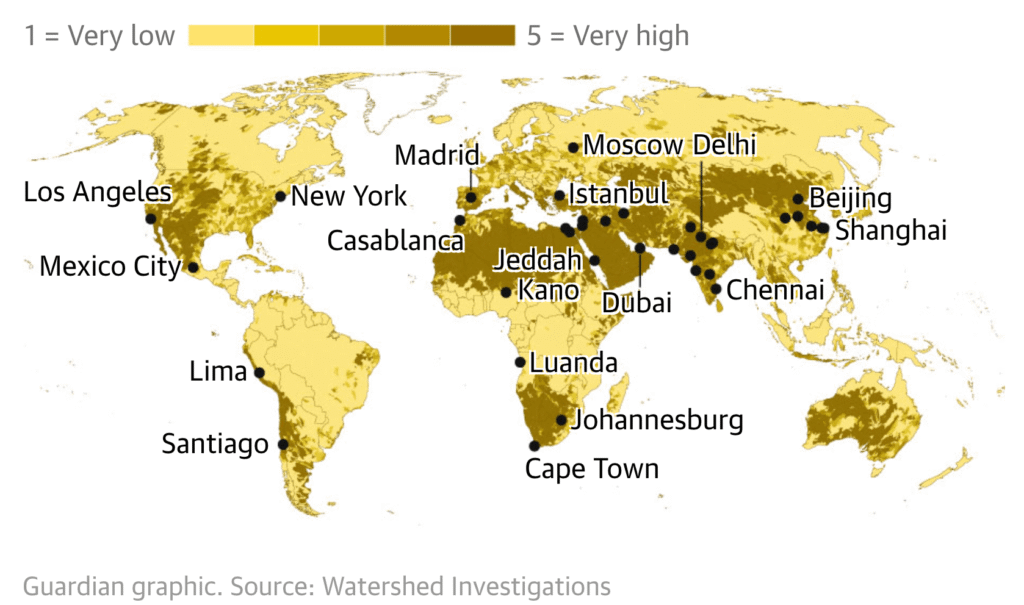
Mapping by Watershed Investigations shows that major global cities such as Beijing, New York, Los Angeles, Rio de Janeiro, and Delhi are already facing extreme water stress. Other major urban centres, including London, Bangkok, and Jakarta, are classified as highly water-stressed, putting millions of people at risk of future shortages.
Satellite Data Reveals Drying and Wetting Trends Worldwide
Separate research using NASA satellite data, analysed by scientists at University College London, reveals how water availability has changed across the world’s largest cities over the past two decades.
Cities such as Chennai, Tehran, and Zhengzhou are experiencing strong long-term drying trends, while Tokyo, Lagos, and Kampala show significant increases in water availability. These trends are visualised in a new interactive water security atlas, covering all 100 cities.
Over a Billion People Live in Drying Regions
An estimated 1.1 billion people live in or around major cities located in regions undergoing long-term drying. By contrast, only around 96 million people live in urban areas experiencing strong wetting trends.
Most cities in wetting regions are found in sub-Saharan Africa, with only a few exceptions elsewhere, such as Tokyo and Santo Domingo. Meanwhile, the most severe drying trends are concentrated across Asia, particularly in northern India and Pakistan.
‘Day Zero’ Water Shortages Becoming a Global Reality
Some cities are already approaching catastrophic water shortages. Tehran, now in its sixth year of drought, is close to “day zero” – the point at which taps run dry. Iran’s president has warned the city may need to be evacuated if conditions worsen.
Other cities, including Cape Town and Chennai, have narrowly avoided day zero in recent years. Alarmingly, many of the world’s fastest-growing cities are located in drying regions, increasing the risk of future water crises.
The World Has Entered “Water Bankruptcy”
The United Nations has warned that the world has entered a state of water bankruptcy, where the degradation of some freshwater resources is now permanent and irreversible. According to Prof Kaveh Madani of the UN University Institute for Water, poor governance and mismanagement are often the primary causes, with climate change acting as an accelerant rather than the sole driver.
“Climate change is like a recession on top of bad management of business.”
Freshwater Reserves Are Declining at an Alarming Rate
The World Bank Group reports that global freshwater reserves have declined sharply over the past 20 years. The planet is losing approximately 324 billion cubic metres of freshwater every year – enough to meet the annual needs of 280 million people. These losses are impacting major river basins on every continent.
Water Scarcity Is a Growing Risk in the UK
In the UK, the Environment Agency warns that by 2055, England could need an additional 5 billion litres of water per day to meet public demand – more than a third of current supply levels. Agriculture and energy production may require a further 1 billion litres per day.
hamsudduha said the “hidden resource of groundwater offers the UK a more climate-resilient water supply”, but added that “without sustained monitoring and better management we risk managing it blindly amid intensifying development and climate pressures”.
Recent water outages in southern England have already exposed vulnerabilities in the system. Regulators have raised serious concerns about water security, even before winter storms disrupted supply.
UK Government Announces Water System Reforms
In response, the UK government has published a new water white paper outlining plans to overhaul the water system. Proposed measures include appointing a chief water engineer, introducing regular infrastructure “MOT checks”, and granting stronger powers to a new water regulator.
At Natural World Fund, we recognise that the global water crisis is not only an environmental challenge, but a growing threat to human security, food systems and economic stability. As water stress intensifies across the world’s largest cities, the mismanagement and depletion of vital freshwater ecosystems puts billions of people at risk. Protecting rivers, wetlands and watersheds — and the natural systems that regulate and store water — is essential to safeguarding biodiversity, ensuring food and water security, and building a resilient future the UK and the wider world depend on.