

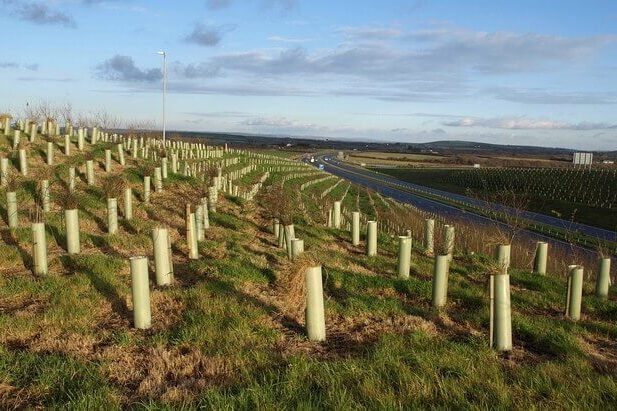
More than one in five trees planted using taxpayer funding in the UK died during last year’s drought, pushing the country further off track from meeting its legally binding tree cover targets.
Figures obtained through a Freedom of Information request reveal that at least 821,177 saplings — 22% of the total planted — were lost due to prolonged hot and dry weather conditions.
Why Tree Planting Matters for Net Zero and Biodiversity
Expanding tree cover is a key pillar of the UK’s net zero strategy, as forests absorb carbon dioxide from the atmosphere.
Well-planned woodland creation can also:
- Enhance biodiversity
- Restore natural habitats
- Reduce flood risk
- Improve soil health
However, these benefits depend heavily on how and where trees are planted.
UK Falling Behind Tree Planting Targets
The UK government has set a goal of planting 30,000 hectares of new woodland each year.
Yet in 2024/25, only around half that target was achieved across England, Scotland, Wales, and Northern Ireland.
This shortfall highlights growing challenges in scaling up tree planting efforts under increasingly extreme climate conditions.
National Trust Struggles to Meet Tree Planting Goals
As one of the UK’s largest landowners, the National Trust aims to plant 20 million trees by 2030.
So far, however, only four million trees have been planted, putting the charity significantly behind schedule.
Extreme weather has been a major factor, with drought conditions causing widespread losses across new woodland projects.
Luke Barley, senior adviser on woodlands at the National Trust, said the charity had “more trees dying than we would hope and anticipate if it hadn’t been for drought”.
Record Heat and Drought Devastate Saplings
The UK experienced its hottest summer on record in 2025, with large parts of England and Wales facing months of drought.
These conditions proved devastating for young trees:
- Some projects reported up to 40% sapling loss
- Typical expected losses are only 10–15%
This sharp increase in mortality is raising concerns about the resilience of current planting strategies.
Millions in Public Funding at Stake
Around £80 million in annual grants is allocated in England alone for tree planting, with similar funding schemes across the devolved nations.
In response to last year’s drought:
- The Forestry Commission provided additional funding to replace dead saplings
- 115 woodland managers applied for support
- Nearly £1 million is expected to be paid out for replacements
However, the true number of lost trees is likely higher, as official figures only include projects eligible for replacement funding.
Adapting Tree Planting to Climate Change
Organisations like the National Trust are already adapting their approach to cope with more extreme weather.
New strategies include:
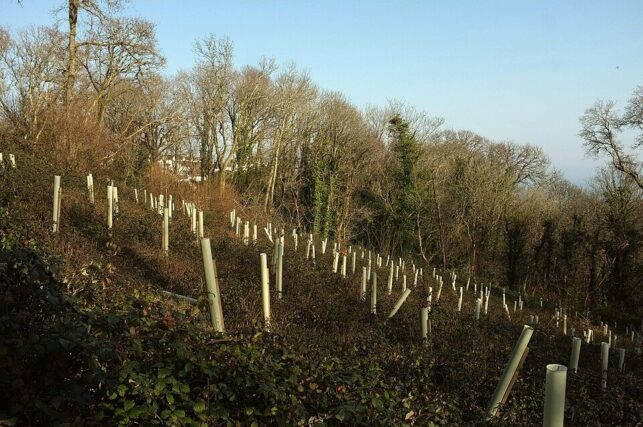
- Planting earlier in the winter
- Using mulch (such as wood chips) to retain moisture
- Increasing reliance on natural colonisation
Natural colonisation allows trees to grow from naturally dispersed seeds, often resulting in stronger root systems and greater resilience.
However, these methods can be slower, more labour-intensive, and more expensive.
Tree Planting vs Rewilding: Ongoing Debate
There is growing debate among ecologists about the most effective way to increase tree cover in the UK.
Some experts argue that:
- Too much funding is directed toward tree planting schemes
- Not enough emphasis is placed on rewilding and natural regeneration
Concerns have also been raised about:
- Low biodiversity in newly planted forests
- Heavy reliance on non-native monocultures for timber production
Guy Shrubsole, an environmental campaigner, said: “Tree planting has its place, but right now the incentives are skewed far too much in favour of planting over natural regeneration. Ministers need to change these ridiculous rules if they want to stand any chance of meeting their own targets for woodland creation.”
Lack of Genetic Diversity Raises Concerns
Research from the Royal Botanic Gardens, Kew found that many planted woodlands suffer from limited genetic diversity, due to reliance on a small number of seed suppliers.
Improving genetic variation could:
- Increase resilience to pests and disease
- Help trees survive in harsher climates
- Reduce long-term mortality rates
However, natural regeneration alone is not a complete solution, particularly given the fragmented nature of UK woodlands.
Are Trees Enough to Tackle Climate Change?
While tree planting plays an important role in climate action, some scientists caution against overstating its impact.
Critics argue that:
- Tree planting alone cannot offset emissions at scale
- It is sometimes used by corporations as a carbon offsetting strategy
Dr Alessandro Gimona, a senior scientist at the James Hutton Institute, said the idea “we’re going to mitigate climate change through planting lots of trees” is “a bit of a myth that can be oversold”.
For example, companies like Microsoft have funded large-scale tree planting initiatives while continuing to invest in energy-intensive infrastructure.
“What concerns me is that forests can be seen as an alternative to cutting emissions and they’re not…anything that offsets can help and also can delay a little bit the effects of climate change but it cannot be seen as a final solution,” Gimona said.
The Bigger Picture: Rethinking UK Tree Strategy
There is broad agreement that the UK must significantly increase tree cover to combat climate change.
However, the data suggests that success will depend on:
- Smarter planting strategies
- Greater biodiversity and genetic resilience
- Long-term ecosystem restoration
- Adapting to a warming, more unpredictable climate
Without these changes, tree planting efforts risk falling short — both environmentally and economically.
Support UK Rewilding Efforts
At Natural World Fund, we support science-led, climate-resilient conservation that goes beyond simply planting trees. By prioritising biodiversity, natural regeneration, and long-term ecosystem health, we can create woodlands that truly survive and thrive—benefiting both people and nature for generations to come.
If you care about restoring native wildlife in the UK, support the work of Natural World Fund today.
Image sources
- Tree guards, Occombe valley – geograph.org.uk – 7466784 by Derek Harper. Cropped and resized from original.: Wikipedia Commons
- Tree guards, Victoria Interchange – geograph.org.uk – 1629287 by Derek Harper. Cropped and resized from original.: Wikipedia Commons