

Wardrew Woodland and Hedgerow Project
Shade for a Northumberland sike: new woodland, hedgerows and an avenue of trees at Wardrew, planted to link habitats and help a tributary of the River Irthing.
LOCATION
Wardrew Farm, Gilsland, Cumbria
NEW WOODLAND
4.71 ha (gross)
HEDGEROW
481 m
DELIVERY
Aug 2024 – Mar 2025
Why This Project
Wardrew Farm sits near Gilsland on the Northumberland–Cumbria border, in a landscape that matters far beyond the farm gate. Water from the farm drains into Greenhole Sike, a small tributary of the River Irthing, which flows on through the Irthing Gorge SSSI and into the River Eden, a Special Area of Conservation. What happens on this land travels downstream, and every metre of healthy habitat here helps the protected rivers below.
Open, grazed ground leaves a sike exposed to summer sun and heavy rain. Native woodland changes that. Dappled shade keeps the water cooler for aquatic life, leaf litter feeds the river’s food web, roots hold banks together and slow the flow, and new hedgerows and trees link the land’s wildlife to the wider landscape.
The area is already valuable ground, with peat and breeding wader habitat (including curlew and lapwing) that tree planting could easily harm. So the woodland was designed to restore without overreaching: low-density, clumped planting with soft, feathered edges, kept clear of the peat and the open ground the waders depend on. The result is more nature, not a trade-off against the nature already there.
What we set out to achieve
– Increase habitat connectivity and biodiversity through woodland creation and new hedgerow
– Regulate the temperature of Greenhole Sike through dappled shade
– Add nutrients to the Irthing Gorge SSSI through leaf litter, and support aquatic life with native broadleaves such as hawthorn, rowan, alder and birch
– Contribute to natural flood mitigation
– Keep planting away from peat and breeding wader habitat, using clumped planting with a feathered edge to mimic nature
What we delivered
Sike woodland
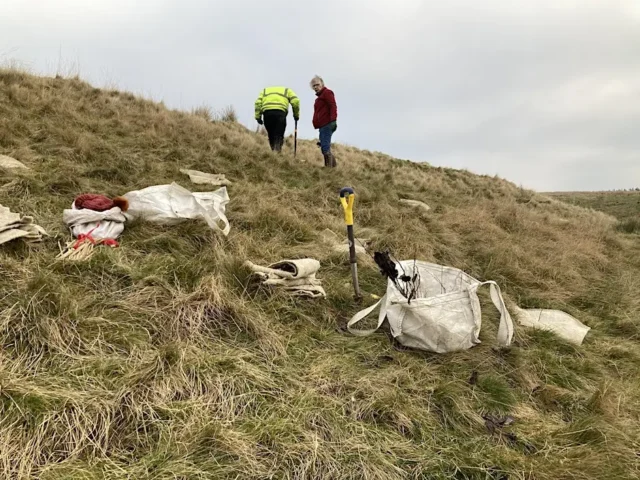
A low-density, clumped woodland of eight native species in equal shares: hawthorn, goat willow, eared willow, bay willow, common alder, aspen, rowan and downy birch. Each of the 2,528 trees has a guard, mulch mat and two applications of deer repellent.
Hedgerow
481 m of mixed native hedge, around 2,886 plants, with stakes, spirals and standard trees. Hawthorn leads the mix, with blackthorn, hazel, dog rose, bird cherry, crab apple and rowan.
Avenue
A double-lined avenue at roughly 10 m spacing, using 150 feathered trees in parkland guards. Species include sessile oak, Scots pine, small-leaved lime, hornbeam, field maple, walnut, aspen, copper beech, rowan, bird cherry and crab apple.
Fencing
734 m of sheep netting protecting new hedge and planting from livestock.
Planting with the landscape
The site is close to protected habitats and used by breeding waders, so the design was shaped by surveys and consultation before any planting started. Bird survey results, local records and a peat check informed where trees went. All planting sits within an existing predator shadow, and the woodland was kept at a low density, with the sike corridor left open to avoid encroaching on peat or wader habitat.
The low stem density and use of tree guards in place of deer fencing meant the woodland was not suited to other woodland creation grants, which is where the Great Northumberland Forest Fund came in.
Looking after it
The trees are protected for the long term. The landowner has committed to keep the planted land in their ownership for at least 15 years, to retain the trees as best they can, and to tell the funder before any change to its use. We will keep an eye on survival and growth as the new woodland and hedgerow establish.
Who benefits
Wildlife
Connected woodland, hedge and scrub habitat for birds, invertebrates and mammals
River System
Greenhole Sike and the River Irthing, through shade, cooler water and leaf litter
Land
The area with shelter for livestock and a more resilient landscape
Northumberland Forest
The wider Great Northumberland Forest, adding to tree cover across the county
Funding and partners
This project was funded with £42,253.88 from the Great Northumberland Forest Fund, provided by the Department for Environment, Food and Rural Affairs (Defra) and managed by Northumberland County Council.

Natural World Fund delivered the project for the landowner. Trees were sourced from Plant Healthy registered nurseries.
See our Projects page for more like this.