

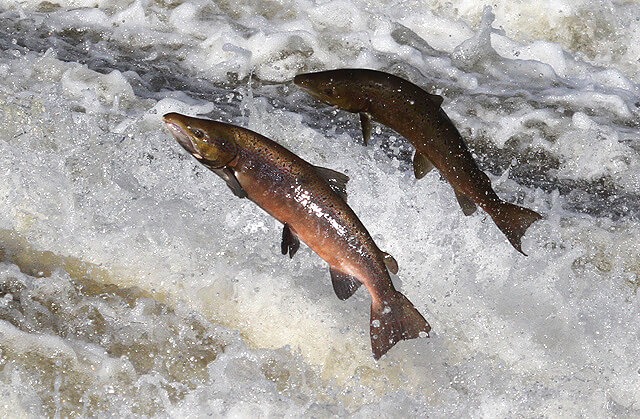
Wild Atlantic Salmon Face Mounting Pressures in Ireland
The dramatic decline of wild Atlantic salmon in Ireland’s rivers has prompted renewed calls for urgent river restoration, with anglers and conservationists warning that entire freshwater ecosystems are being lost.
For lifelong angler and quarry owner Michael Harding, the deterioration of rivers near Gowran and Goresbridge in County Kilkenny has unfolded over decades.
Harding says salmon, along with trout and countless other freshwater species, once thrived in these waterways but have now almost disappeared.
“There are pools where people once poached salmon in winter that can now almost be walked in boots,” he said.
He believes excessive road runoff, sediment and construction material washing into rivers are damaging vital spawning habitats.
“We are seeing every bit of gravel and dirt from tractors and trailers being flushed straight from the road into the river. The number of smolts are not only getting scarcer, they are also getting smaller. Some of the ones we saw this year are tiny and not able to survive or get away from predators.
“I’ve seen the gradual decline. The bigger pools have practically disappeared. Sixty years has gone by and there is nothing left in the river.
“Goresbridge anglers, which was kept alive for 60 years, is now gone. Why would you bother when there is nothing left in the river?”
Restoration, Not Just Conservation
Harding argues that while conservation receives significant attention, active river restoration has been neglected.
“There is a huge focus on conservation but what we need is restoration. Absolutely nothing is being done to restore our rivers. I have raised this with IFI many times.”
His comments come shortly after Salmon Watch Ireland raised similar concerns during the North Atlantic Salmon Conservation Organisation (NASCO) Conference 2026 in Aviemore, Scotland.
The conference brought together politicians, scientists and indigenous representatives to discuss the widespread decline in Atlantic salmon populations.
Scientific assessments presented by the International Council for the Exploration of the Sea highlighted historically low salmon numbers, attributing declines to a combination of climate change, habitat degradation, disease and other environmental pressures.
A Lifetime Dedicated to One River
Harding’s connection to the river began in childhood after contracting polio.
Unable to participate in sports, he instead spent much of his youth fishing and exploring the river, giving him an intimate understanding of its changing condition.
“Having polio as a child meant those things weren’t available to me,” he said “That’s why I got into fishing instead. There was one advantage to having the condition because it made me more familiar with the river than a lot of other people.
“My left leg is shorter than my right leg. Because most of my walking is dependant on my right leg I can’t have one leg on soft ground. This meant I was well aware of where I could go in the river and where I couldn’t. As a result of this experience I can recognise the changes in the river since my childhood.”
Why Salmon Can No Longer Spawn Successfully
According to Harding, decades of sediment build-up and construction debris have hardened riverbeds, making it increasingly difficult for female salmon to create spawning nests, known as redds.
“What’s happening is that a lot of the surface runoff and historic dumping has washed all this debris down the river but there is something even more sinister at play.
“The bottom of these rivers have become really hard. You can see where the stones have filled up. What happens with the salmon is they come up and lay eggs. The hen has to dig a salmon redd which is a nest in the riverbed to lay her eggs in.”
He explained the process salmon use to reproduce and why unsuitable material now covering riverbeds is preventing successful spawning.
“She digs a hole in the gravel that is usually about 2ft long and anywhere between six inches and a foot deep. She will then move up and disperse the eggs eight or 10 miles away so they have a better chance of surviving. She has to flap her tail enough to get the stuff up from the bottom.
“Keep in mind that we can’t get through this with a shovel and a fish has to do it with her tail. If you look at many of the stones here you will see that they don’t belong to the river and are in fact building material. It’s crazy the amount of building materials that are here that have no place in the river. The problem is that salmon can’t dig a hole through it.”
Entire Freshwater Ecosystems Are Being Lost
Harding says the disappearance of salmon is only one part of a much larger ecological decline.
He believes trout, freshwater crayfish, freshwater mussels, aquatic invertebrates and river flies have all suffered significant losses.
“Over the years I’ve seen the river get shallower but nobody thought too much about it. Invertebrates are the smallest form of river life. They end up being food for fly larvae — commonly known as maggots — and flies.
“When the invertebrates disappear the flies disappear too which is what has happened in the river. There should be billions of these deep down in the river. The only thing that can live here now is what can survive on the surface of the river.
“What’s happening is the runoff is being piped directly into the river. I’m seeing a lot of stones that are straight out of buildings. I know building stone a mile away because I run a limestone quarry and I’ve been taking this stuff out for years.
“There is a much wider aspect to this. This is primarily about salmon but the trout are gone, the river flies are gone, the freshwater crayfish are gone as well as the freshwater mussels.
“The other thing that people don’t seem to understand is that flies, while in flight, are the main food of swallows too. The number of swallows returning to Ireland can be directly related to the lack of flies because they don’t have anything to eat.”
Calls for Reform of River Management
Despite his concerns, Harding believes recovery remains possible if practical restoration measures are implemented.
“There is no reason this river can’t be recovered. If I decided in the morning that I wanted to restore this part of the river, I could.
“However, if I put a digger here to do what IFI don’t seem to know how to do, it would result in me being prosecuted immediately. I am being told that the problems are down to calcification but this is only part of the problem.
“What is taking place is an utter systematic failure. The utter hopelessness is not in the river, but rather within the system itself.”
He argues that bureaucracy has become one of the biggest barriers to restoring damaged rivers.
“It is caught in a systematic interagency paralysis which prevents, not only agencies from restoration but all interested parties, even though funding is available to resolve it.
“The overreliance on science to identify problem sources is hindering straightforward mechanical issues which could easily be resolved and should at the very least be investigated and tried.
“Twenty years of failure indicates to me at least that this science-based logic is simply incorrect on its own and the evidence is there of that utter failure. The agencies need to either be removed from the task or forced to test other avenues.
“In relation to the rivers, the biggest problem I have is that the blame is being placed anywhere that the government agencies can’t do anything about. A lot of it is being put down to the unpaved agricultural roads, but most of these unpaved agricultural roads are in grasslands.”
Ocean Threats Also Endangering Atlantic Salmon
John Murphy of Salmon Watch Ireland said concern for Ireland’s salmon has intensified, with evidence suggesting problems extend far beyond freshwater rivers.
“The causes of the overall decline are not set in concrete,” he said.
“There are a lot of issues which are common to all countries. We experience a lot of pollution from agriculture and wastewater treatment plants. There is also the intensification of agriculture to consider, which is basically destroying rivers.
“We still have some rivers in Ireland that have pristine conditions and should have a stable population. However, they are also declining which leads us to believe that the biggest issues are in the ocean.
“We have made some recommendations in regards to bycatch at the sea.”
Murphy said accidental capture, known as bycatch, may be having a greater impact than currently understood.
“There are enormous pelagic fleets operating now in the Norwegian Sea. Our salmon and a lot of other salmon from other countries go in their first year. There has to be a significant bycatch which was one of the issues that came up at the conference.
“Salmon is now part of a mandatory bycatch reporting system. In other words, pelagic fleets have to report salmon in their bycatch. They didn’t have to do this before but initial observations would suggest that people are still not reporting them.
“I imagine that pelagic skippers would not always be inclined to report salmon due to the fact that they might be told they can’t fish in certain areas. There seems to be very low numbers in bycatch, but it’s difficult for the pelagic trawlers to see this because they’re landing vast quantity of fish.
“If you’re landing thousands of tonnes of fish it’s going to be difficult to find juvenile salmon among them.”
He added:
“The catches won’t be reduced by regulation. They will be reduced by collapse.”
Inland Fisheries Ireland Responds
Inland Fisheries Ireland (IFI) said it is responsible for managing fish populations in Ireland’s rivers, lakes and coastal waters but noted that it does not have legal powers under the Waste Management Act to remove unauthorised construction waste.
The organisation said reports of illegal dumping or road runoff should be referred to local authorities and stressed that reducing calcification requires improved land management, better industrial dewatering controls and increased climate resilience across river catchments.
IFI said calcification can result from a combination of agricultural runoff, nutrient enrichment, naturally occurring limestone geology, groundwater interactions, warmer water temperatures and some industrial dewatering activities.
The agency added that simply removing calcium deposits would not address the underlying causes of river degradation.
Protecting Healthy Rivers for Wildlife
At Natural World Fund, we support evidence-based conservation and habitat restoration that protects freshwater ecosystems for future generations. Healthy rivers support far more than Atlantic salmon. They provide essential habitat for fish, freshwater invertebrates, birds, mammals and countless other species that depend on clean, flowing water. Restoring degraded river systems can improve biodiversity, strengthen ecosystem resilience and help wildlife adapt to growing environmental pressures.
If you care about restoring native wildlife, support the work of Natural World Fund today.
Image sources
- Leaping_salmon_at_Murray’s_Cauld,_Philiphaugh_-_geograph.org.uk_-_2136546 by Walter Baxter. Cropped and resized from original: Wikipedia Commons
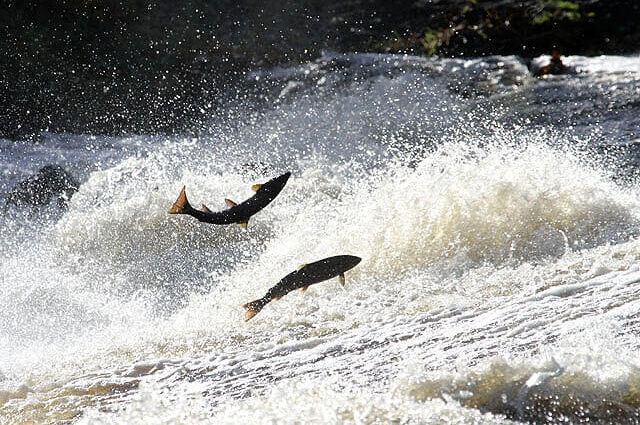
- Jumping_salmon_at_Murray’s_Cauld,_Philiphaugh_-_geograph.org.uk_-_3191883 by Walter Baxter. Cropped and resized from original: Wikipedia Commons