

Hiroshima Oyster Crisis: Climate Change Threatens Japan’s Seafood Heritage
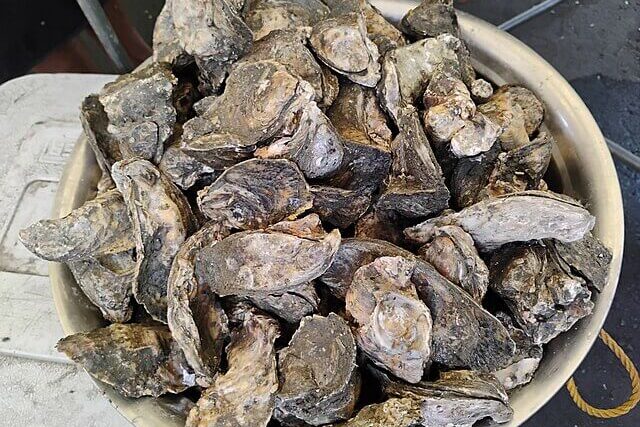
The famous oyster stalls at the annual festival in Kure are usually a symbol of abundance. Visitors queue eagerly as chefs grill fresh shellfish, waiting for the oysters to open and reveal their rich, briny interiors.
But this year tells a different story.
Festivalgoers like Nobuyuki Miyaoka have noticed a worrying trend. The oysters, once prized for their size and flavour, are now noticeably smaller and harder to find.
“The local oysters were fine until this year,” he says. “They used to be a lot bigger … look how small they are.”
Across Hiroshima Prefecture, oyster vendors are struggling to meet demand. What should be a celebration of one of Japan’s most iconic foods has become a reflection of a growing environmental crisis.
Mass Oyster Die-Offs Linked to Rising Sea Temperatures
The region’s oyster industry is facing unprecedented losses. Experts attribute the crisis to rising sea temperatures and extreme weather, particularly last year’s intense heatwave in Japan.
Warmer waters reduce oxygen levels and disrupt the delicate balance oysters need to survive. As a result, mass die-offs are becoming more frequent, threatening both marine ecosystems and local economies.
Fisheries in Crisis: Livelihoods at Risk
Local oyster farmer Taketoshi Niina describes this season’s harvest as a “disaster.”
“This is something out of the ordinary. And a lot of those that do survive are in poor condition … they are not of a high enough quality to sell to shops and restaurants.
“This is beginning to hit us financially. The season isn’t over yet, and next year is also looking bad. We’re all exhausted. If this happens again next year then it’s going to threaten businesses.”
In some areas, up to 90% of oysters have died—far above the typical 30–50% loss rate. For small fisheries, this is devastating. Many families who have relied on oyster farming for generations now face an uncertain future.
“I’ve never experienced this in my whole career,” says Tatsuya Morio, who has farmed oysters in Hiroshima for more than 20 years.
The impact stretches across the Seto Inland Sea, a region responsible for around 80% of Japan’s oyster production.
Hiroshima produces nearly two-thirds of Japan’s farmed oysters, making it central to the country’s seafood industry. In 2023 it produced a massive 89,000 tons of the shellfish.
Oysters are not just a culinary staple—they are vital to local economies, cultural identity, and sustainable aquaculture practices.
Climate Change and Ocean Warming: A Growing Threat
According to Kazuhiko Koike of Hiroshima University, unusually warm and stagnant water conditions are a key factor behind the die-offs.
“If higher temperatures remain for a few weeks, that weakens oysters and makes them more susceptible to viruses and bacteria,” says Shoichi Yokouchi, the head of the marine products division at the Hiroshima prefectural government.
When surface water heats up, it fails to mix with cooler layers below. This reduces oxygen levels near the seabed, starving oysters of the conditions they need to survive.
In response to the crisis, Japan’s fisheries agency has introduced emergency measures, including low-interest loans and financial aid programmes to support aquaculture businesses.
“Kure’s oyster production is among the top in the country, and it supports a wide range of sectors – not only fisheries but also local employment in distribution and food tourism,” says Tomonori Uemoto, director of the fisheries promotion office at the Kure municipal government. “So [the oyster deaths] are likely to have a significant impact.”
While these measures may offer short-term relief, they do not address the root cause: climate change and rising ocean temperatures.
“It is possible to say that various abnormal environmental conditions caused by global warming and climate change – such as high air and water temperatures, low oxygen levels, insufficient rainfall, nutrient and food shortages are causing oysters to die en masse,” Koike says.
“It’s difficult to put the brakes on climate change,” he says. “But if the rainy season ends early again with little rainfall, and is followed by prolonged high temperatures and hot weather, this could mean that low oxygen levels and food shortages will occur again.
“If that happens, it might be possible to move the oyster rafts to areas with slightly lower water temperatures and more food, or to suspend the oysters at bigger depths to avoid high water temperatures.”
A Warning for Global Marine Ecosystems
The situation in Hiroshima is not an isolated incident. It highlights a broader global issue—how climate change is disrupting marine life and food systems.
Back in Kure, businesses are already feeling the impact. Restaurants are closing earlier due to shortages, and traditional offerings—such as gifting oysters through local tax programmes—are being scaled back.
For farmers like Niina, the question is no longer about growth, but survival. Without meaningful environmental action, the future of oyster farming in Japan—and beyond—remains uncertain.
“My son decided a couple of years ago that he wants to take over the business after I retire,” he says. “But this year I’ve begun to really worry whether there is a future for him.”
At Natural World Fund, we see the oyster crisis in Hiroshima Prefecture as part of a wider global threat to marine ecosystems. Rising ocean temperatures and climate pressures are putting vital species and coastal livelihoods at risk. Without urgent action to protect ocean health and cut emissions, these impacts will only intensify.
If you care about restoring native wildlife in the UK, support the work of Natural World Fund today.
Image sources
- Oyster_farm,_Baltasound_-_geograph.org.uk_-_971453 (1): Wikipedia Commons
- Oyster_-_Talaba_(Legazpi_Sunday_Market,_Makati) (1): Wikipedia Commons