

Natural England Accused of Failing to Protect Endangered Wildlife Sites
England’s system for protecting rare wildlife and habitats is facing growing criticism after a new report claimed the government’s nature watchdog has stopped granting protection to important ecological sites.
According to planning experts working with the campaign group Wild Justice, no new Sites of Special Scientific Interest (SSSIs) have been designated by Natural England since 2023. Conservationists warn this lack of action is leaving vulnerable species and habitats increasingly exposed to development.
SSSIs are among the UK’s strongest environmental protections, covering areas considered nationally or internationally important for wildlife, geology, or rare habitats. Without official designation, these sites can be far more vulnerable to housing, infrastructure, and industrial projects.
What Are SSSIs and Why Do They Matter?
Sites of Special Scientific Interest were first introduced in 1949 to help safeguard the country’s most valuable natural environments. They play a crucial role in protecting endangered species, wetlands, ancient woodlands, coastal habitats, and important insect populations.
Developers are normally required to reduce environmental harm when building close to an existing SSSI, and planning applications can even be refused if protected habitats are threatened. However, sites awaiting designation receive far weaker safeguards.
The new report by planning experts found that 14 potential SSSI sites currently sitting in Natural England’s “designations pipeline” have already faced major development applications within 1km of the proposed protected areas. Alarmingly, 12 of those developments have been approved.
Bob Elliot, the chief executive of Wild Justice, said: “While Natural England dithers and ‘reviews processes’, irreplaceable wildlife sites are being trashed, damaged, and even built over. That is not a technical failure, it’s a dereliction of duty.
“The idea that we can protect nature at a landscape scale while failing to designate the very best sites is absurd. You don’t save nature by leaving its most important places unprotected and hoping for the best.
“This must change immediately. The designation pipeline needs to be reopened, sites must be designated without further delay, and the government must stop starving the system of resources. Every day of inaction risks losing more of what little wildlife we have left and once it’s gone, it’s gone for good.”
Researchers said the 1km assessment likely underestimates the true ecological impact, as urban development often affects wildlife far beyond immediate site boundaries.
“This is a very conservative estimate of harm, since many types of urban development inflict damage on ecology over a much wider radius.”
Thurrock Wildlife Site to Be Lost to Tilbury 3 Port Development
One of the most controversial examples highlighted in the report is a proposed SSSI site in Thurrock, Essex.
Part of the area — known as “Ashfield A1” — is set to be destroyed by the new Tilbury 3 port development, which received planning permission earlier this year. The scheme will also damage part of the West Tilbury Marshes local wildlife site, an area Natural England has described as one of the most important locations for invertebrates in the North Thames region.
Natural England had reportedly gathered evidence supporting future protection of the site and indicated a formal designation decision could have been expected in 2025.
They said that “Natural England is in the process of reviewing its limited resources to consider how they can most effectively be used to achieve and support the restoration of nature.”
The wider Thames Estuary region was added to Natural England’s protection pipeline in 2020 due to growing concern over habitat destruction and insect declines. Earlier studies by conservation charity Buglife found that more than half of the area’s most important insect habitats had already been lost or were under immediate threat from development.
Amanda Craig, the director of resilient landscapes for Natural England, said: “Sites of special scientific interest are the foundation of England’s most precious habitats and species, and form the core from which wider nature recovery can spread. Natural England has a rolling programme to keep under review places that may merit and benefit from designation as SSSIs.”
Report Finds Most Potential Wildlife Sites at Risk
The report, written by Dr Kiera Chapman, Professor Malcolm Tait and Dr Rob Davies, concluded that nearly two-thirds of proposed SSSI sites are now considered at high risk from development pressure.
In several cases, major construction projects were included in local authority development plans before any wildlife protection could be finalised.
Sites including Bernwood Forest in Buckinghamshire are also facing uncertainty from future large-scale infrastructure proposals linked to HS2 and East West Rail developments.
Meanwhile, coastal areas such as Filey Brigg to Scarborough South Bay and Flamborough Head have reportedly remained on Natural England’s designation waiting list for over a decade without a final decision.
England Falling Behind on Nature Protection Targets
The findings raise further concerns about the UK government’s commitment to protecting 30% of land and sea for nature by 2030.
According to the report, SSSIs currently cover only 7.1% of England — a smaller proportion of protected land than any country in the European Union.
Although Natural England announced plans in 2012 to dramatically increase the number of new protected sites being designated each year, progress has remained slow. Just 33 new SSSIs have been created over the past 14 years, with none added since 2023 and no existing sites expanded.
A separate letter seen by the media reportedly showed Natural England had paused formal assessments for several proposed SSSI sites while it considers new priorities for future designations.
Critics say the delays are creating a dangerous gap in protection at a time when biodiversity loss and habitat destruction are accelerating across England.
Support UK Rewilding Efforts
At Natural World Fund, we support stronger legal protections for wildlife habitats and urgent action to halt biodiversity loss across the UK. Rare ecosystems, wetlands, ancient woodlands, and insect-rich landscapes are disappearing at an alarming rate, often before protections can be put in place. Safeguarding important natural areas now is essential if future generations are to inherit a healthier, more resilient environment.
If you care about restoring native wildlife in the UK, support the work of Natural World Fund today.
Image sources
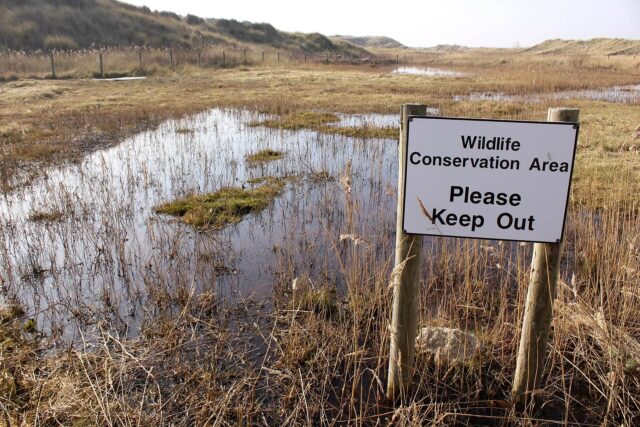
- Wildlife Conservation Area at Gronant Dunes SSSI by Jeff Buck. Resized from original: Wikipedia Commons