

Massive Pacific Marine Heatwave Raises Climate and Ecosystem Alarm
A vast and persistent marine heatwave off the west coast of the United States is intensifying, with scientists warning of growing ecological disruption across the Pacific Ocean. New data suggests the extreme warming event is expanding, threatening marine ecosystems, altering weather patterns, and amplifying climate impacts across North America.
Stretching thousands of miles from California across the Pacific Ocean, the heatwave in the vast triangle-shaped region of oceanic habitats is now one of the most significant ocean temperature anomalies recorded in recent years.
“I’m out of superlatives,” Kim Wood, a University of Arizona atmospheric scientist, wrote on social media. Wood was reacting to data showing ocean temperatures in the eastern Pacific had risen to a level warmer than typically seen during peak hurricane season.
What Is Driving the Pacific Marine Heatwave?
The marine heatwave, which peaked in size in September 2025, continues to cover an enormous area of ocean stretching:
- From the west coast of North America
- Across the central Pacific towards Hawaii
- Northwards to British Columbia
- Southwards towards Mexico
Scientists initially hoped the system would weaken in spring 2025, but updated projections released from the U.S. National Oceanic and Atmospheric Administration (NOAA) indicate it is likely to expand and intensify further.
Researchers warn that it may now coincide with the development of an El Niño event, creating a powerful combination of ocean and atmospheric warming.
Ocean Warming and Climate Change Interactions
Climate scientists say the unusual persistence of warm Pacific waters is contributing to broader climate instability.
Key concerns include:
- Reinforcement of atmospheric heat across North America
- Disruption of marine food chains
- Changes to global weather patterns
- Increased likelihood of extreme temperature events
Abnormally warm Pacific Ocean waters absorb and store heat, which can later be released into the atmosphere, intensifying both summer heat and winter weather anomalies.
Scientists believe this interaction is being amplified by human-driven climate change, making extreme ocean events more frequent and severe.
Extreme Weather Impacts Across the United States
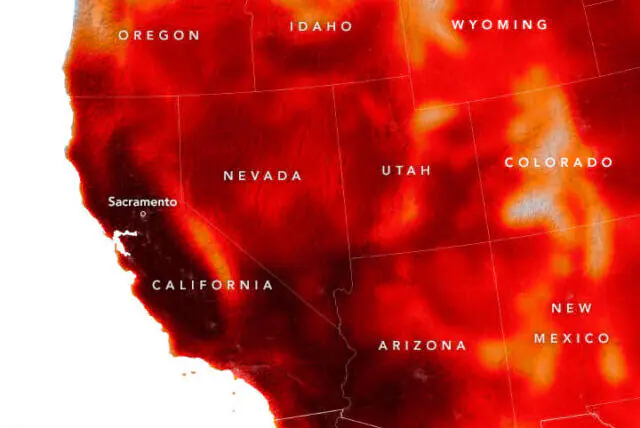
The marine heatwave has already been linked to unusual and record-breaking weather conditions across the United States.
Recent impacts include:
- Temperatures exceeding seasonal norms by more than 30°F (31°C) in parts of the Midwest and western states
- One of the warmest winters on record across the western US
- Widespread temperature records set across hundreds of cities
According to climate researchers at Berkeley Earth, some of these extremes would not have occurred without the influence of human-caused climate change.
Scientists also noted that more than one-third of US weather stations recorded new March temperature records during the event, rivalled only by historic extremes such as the Dust Bowl era.
Drought, Snow Loss and Wildfire Risk in the West
The ongoing heatwave is also contributing to worsening drought conditions across the western United States.
Key environmental impacts include:
- Rapid snowpack decline across Oregon, California and Colorado
- Increased water stress for rivers and reservoirs
- Intensifying drought conditions in already dry regions
- Higher wildfire risk linked to dry thunderstorms
Climate experts warn that unusually warm ocean temperatures may increase humidity inland, potentially triggering storms that ignite wildfires rather than providing rainfall relief.
“There’s real concern right now that even if this marine heatwave didn’t persist, we’re heading into a bad wildfire season with poor water supply conditions,” said Larry O’Neill, an Oregon State University climatologist. “Our summer is going to be much warmer than normal.”
Marine Ecosystems Under Pressure
Beyond land-based impacts, scientists are increasingly concerned about the effects on ocean ecosystems and marine wildlife.
Observed and expected impacts include:
- Shifts in species distribution towards cooler waters
- Northward movement of plankton, fish and seabirds
- Starvation events among seabird populations
- Disruption of marine food webs
During a previous marine heatwave known as “the Blob” in 2015, more than a million seabirds are estimated to have died due to food shortages and ecosystem collapse.
“We often monitor seabird populations to better understand what’s going on in the ocean,” said Don Lyons, a conservation biologist and director of the National Audubon Society’s Seabird Institute.
“We’ve seen this kind of poor success at other times. When we have an El Niño, that’s often associated with nesting failures of many species of seabirds on the west coast, including brown pelicans,” said Lyons. “This year, it was a little bit different in that the early start [to migration] was striking.”
Scientists warn similar patterns may be emerging again, with species such as California brown pelicans leaving nesting areas earlier than usual due to food scarcity.
“Back in 2015, we had drought that year and poor ocean conditions,” O’Neill said. “Whatever salmon went out to the ocean and then came back to spawn, they were returning to rivers that were running really low and really warm. We had really big increased pre-spawn mortality and a lot fewer salmon coming back over the following years.”
O’Neill is especially concerned with the marine heatwave’s impact on salmon.
“This is going to be a big hit on our fisheries for a couple of years.”
El Niño Risk and Global Climate Implications
Meteorologists are also tracking the increasing likelihood of a strong El Niño event later this year. When combined with marine heatwaves, El Niño conditions can significantly amplify global climate disruption.
Potential consequences include:
- More extreme global temperature swings
- Increased risk of droughts and floods
- Further disruption to marine ecosystems
- Heightened wildfire and storm activity
Researchers say the combination of marine heatwaves and El Niño events reflects a growing pattern linked to human-induced climate change, with compounding effects across ocean and atmospheric systems.
Elizabeth Phillips, a research scientist with Noaa Fisheries, is preparing for the annual coast-wide offshore ecosystem assessment.
“The last six months have been really concerning,” said Phillips. “As a scientist, I’m really curious to know what the ecosystem impacts are going to be.”
Monitoring a Rapidly Changing Ocean
Scientists are continuing to monitor conditions using advanced ocean survey tools, including NOAA research vessels that track plankton, krill and fish populations using sonar and ecosystem mapping technology.
“We saw a significant change in the amount of krill that were out on the west coast during the Blob years, 2014 to 2016,” said Phillips, which had a major effect on animals such as seabirds, mammals and salmon that depend on krill. “If there is another drop in krill this year, then I would anticipate there’s probably going to be a lot of those same impacts to the rest of the food web.”
While monitoring capacity has improved, researchers warn that the scale and persistence of marine heatwaves is outpacing expectations, highlighting the urgent need to understand how rapidly changing oceans will shape future climate and biodiversity outcomes.
“One big problem is that these events are happening seemingly more frequently and more intensely,” said Hilary Hayford, a marine ecologist with the Puget Sound Restoration Fund.
“We’re trying to plan for these conservation or restoration actions, and we don’t have the tools to overcome these problems,” said Hayford. “A hope is to have time in between these events for systems to recover. We’re only just now starting to see recovery of sea stars and bull kelp and other species that really suffered cascading effects of the last one.”
Support Environmental Efforts
At Natural World Fund, we support action to protect marine ecosystems and address the climate crisis driving extreme ocean warming. Healthy oceans regulate global temperatures, support biodiversity and sustain life on Earth, making their protection essential for a stable and resilient future.
If you care about restoring native wildlife, support the work of Natural World Fund today.
Image sources
- Caheatwave_geos5_2022249 by Lauren Dauphin and Joshua Stevens, using GEOS-5 data from the Global Modeling and Assimilation Office at NASA. Cropped and resized from original: Wikipedia Commons
- 084_Sun_setting_in_the_Namib_desert_Photo by Giles Laurent: Wikipedia Commons