

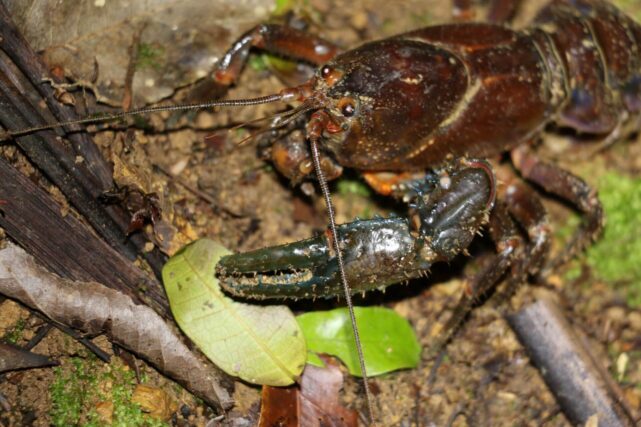
Endangered Spiny Crayfish Under Pressure Across Australia
Deep beneath the shaded waters of Australia’s rainforest creeks lives one of the country’s oldest and least-known creatures: the spiny crayfish. These remarkable freshwater animals have survived for tens of millions of years, but scientists now warn that climate change, habitat degradation and bushfires are placing many species at increasing risk of extinction.
During a nighttime search in an undisclosed part of Queensland’s Sunshine Coast hinterland, conservationist Ollie Scully spent hours wading barefoot through rainforest streams before finally spotting one of these elusive creatures.
“This will not be for the want of trying,” he shouts.
Moments later, his torch beam illuminated a juvenile Conondale spiny crayfish sheltering among the rocks.
“It’s a Conondale … one of the giants,” Scully says.
A Living Relic from Australia’s Ancient Past
The Conondale spiny crayfish is one of 52 known species found only in Australia and is currently classified as endangered. The juvenile discovered during the search measured around 15cm long and displayed a defensive posture after being gently returned to the water. One of its claws was still regenerating.
“Most likely she had a run-in with an eel,” says Scully, only minutes after a metre-long eel – a crayfish predator – glided past his legs. “They can drop their claws in self-defence.”
Scientists believe these remarkable animals diverged from marine crayfish roughly 100 million years ago, making them an ancient component of Australia’s freshwater ecosystems.
Scientists Warn of Escalating Extinction Risks
According to Dr Nick Whiterod, an ecologist and crayfish expert at the Coorong Lower Lakes and Murray Mouth (CLLMM) Research Centre and Adelaide University, public awareness of these animals remains extremely low despite their ecological importance.
“Most Australians are not aware of them,” says Dr Nick Whiterod.
“People could be water skiing or whatever and have no idea there might be thousands of crayfish under their feet.
“But these guys are really threatened and we’ve got concerns about their future.”
Only three Australian spiny crayfish species appeared on the national threatened species list in 2019. Today, that number has risen to 36, with additional species expected to be added.
Whiterod believes coordinated national conservation efforts are urgently needed.
“They split off from the marine crayfish and then from the northern hemisphere crayfish about 100m years ago,” he says.
“So they’ve been here a long time and they’ve withstood everything Australia has thrown at them.
“But the rate of change is escalating in terms of climate and fire and what humans have done to alter their habitat in the last 200 years. A lot of the species are not well adapted to cope with rapid change.”

Climate Change and Bushfires Threaten Freshwater Habitats
Spiny crayfish can live for decades—some possibly reaching 50 years—and inhabit environments ranging from Queensland rainforests to alpine bogs and waterways in South Australia.
However, they face growing threats from invasive predators such as feral pigs and foxes, illegal collection, and damage to the shaded stream habitats they rely upon.
Whiterod identifies climate change as the greatest danger.
“This is all conspiring to make them a highly threatened genus,” he says. “We’re assessing all the species and for all of them there’s worrying signs for their extinction risk.”
The devastating 2019–2020 bushfires affected the habitats of an estimated 40% of Australia’s spiny crayfish species. Fire removes protective canopy cover, raises water temperatures and allows ash and sediment to wash into streams, creating lethal conditions.
“They can’t physiologically cope and they will just cook,” Whiterod says.
WWF-Australia Highlights Importance of Mountain Stream Species
Conservation work supported by WWF-Australia has helped secure critically endangered listings for eight spiny crayfish species.
The organisation’s conservation scientist, Dr Stuart Blanch, describes the animals as vital indicators of ecosystem health.
“Spinies are the canaries in the coalmine for many species living in the delicate ecosystems of our mountain streams.”
“The survival of spinies depends on transitioning away from fossil fuels and stabilising global temperature increases to no more than 1.5C,” he says.
Fascination with Australia’s Elusive Crayfish
For many researchers, studying spiny crayfish quickly becomes a lifelong passion.
Scully recalls discovering his first specimen while searching for threatened frogs.
“It was this enormous crayfish. I’d never seen anything like it. I was instantly obsessed.”
Whiterod says many scientists share that experience.
“They’re not the obvious thing to get obsessed about – people usually go for the furry things – but they’re incredibly captivating. They get under your skin.”
Research associate Rob McCormack first encountered the species while farming yabbies in the early 1980s and has spent the last two decades documenting and identifying Australia’s diverse spiny crayfish.
“Most people know the yabby but the spinies are a different kettle of fish,” McCormack says.
“I was looking at all these weird and wonderful species, and they were mainly the Euastacus. We were cultivating them and that gave me an insight. Then when I sold the business, I started investigating them.
“They’re incredibly long-lived – I could show my children a crayfish in a pool and they could bring their children back and show them the same crayfish in the same pool.
Healthy Crayfish Populations Support Entire River Ecosystems
Researchers emphasise that spiny crayfish play a critical ecological role by supporting the health of freshwater ecosystems.
“They’re the engines that drive the whole river system,” McCormack says. “They’re not a species people should be catching and eating, or putting in a fish tank.
“For one to reach maturity and replace an adult, it’s maybe a 1,000 to one chance. So these are the food sources for all the other animals to live on. Healthy crayfish populations mean healthy streams.”
Both McCormack and Whiterod have witnessed severe population crashes following prolonged droughts and bushfires that wiped out long-established colonies.
“Given enough time, they should recover,” he says. “But if that becomes a regular theme from climate change, then these populations are never going to recover.”
“We are calling on governments to create fully protected ocean sanctuaries that will close vast areas of the ocean off from extractive human activities. Governments have promised to protect 30% of the world’s ocean by 2030 – the minimum scientists say we need for the ocean to be able to recover.”
Protecting Freshwater Species from Climate Change
At Natural World Fund, we support efforts to protect endangered wildlife and the fragile freshwater habitats they depend on. From restoring ecosystems to tackling the drivers of biodiversity loss and climate change, safeguarding species like Australia’s ancient spiny crayfish is essential for preserving healthy rivers and resilient natural landscapes for future generations.
If you care about restoring native wildlife, support the work of Natural World Fund today.
Image sources
- Euastacus_setosus,_Queensland,_AU_imported_from_iNaturalist_photo_171999580 by Greg Tasney. Resized from original: Wikipedia Commons
- Euastacus_setosus_171999627 by Greg Tasney. Resized from original: Wikipedia Commons